Can We Do Better? Rethinking Floors, Shoes, and an Overlooked Contamination Pathway
April 17, 2026
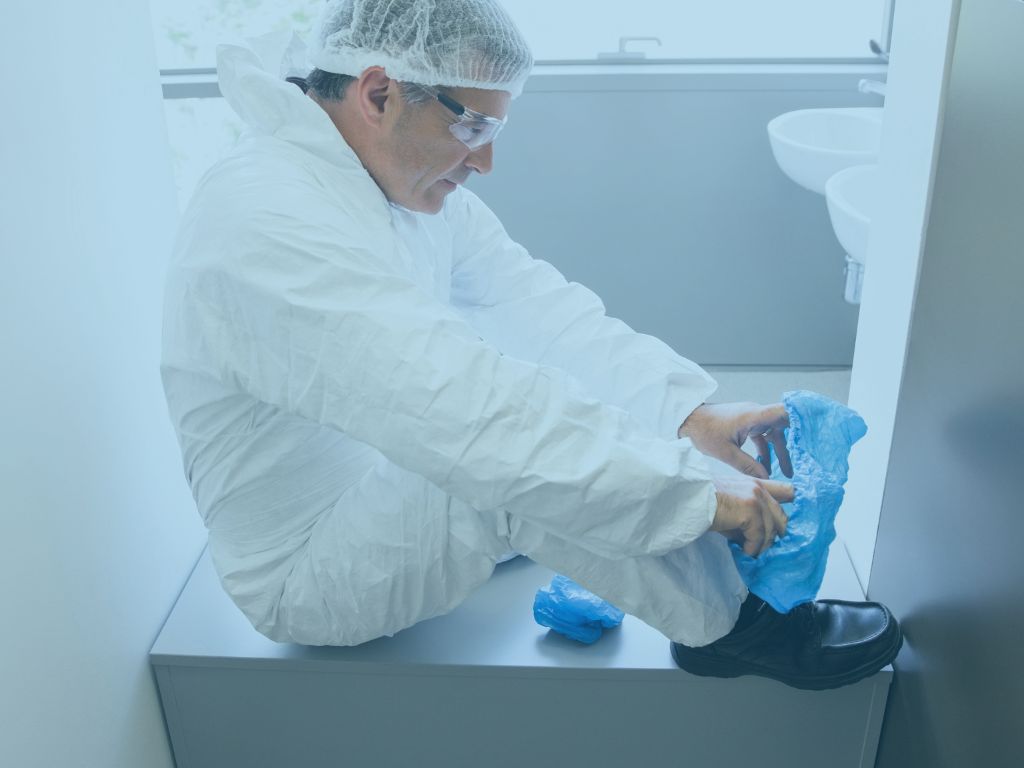
In pharmaceutical and healthcare environments, contamination control often focuses on the obvious: air handling, surfaces, hand hygiene, gowning, and validated cleaning protocols. Entire programs are built around these pillars. Budgets are allocated, staff are trained, and auditors know exactly where to look. But one persistent pathway continues to be underestimated: floors and shoes.
Every day, people move between corridors, staging areas, gowning spaces, production rooms, and support zones. Shoes contact everything the floor collects — dust, residue, moisture, and microbial burden — then carry that material forward with every step. In many facilities, this risk is acknowledged indirectly through policies around traffic flow, cleanable flooring, and shoe covers. Still, the practical question remains: can we do better?
Understanding the Risk
Floors are among the most heavily trafficked surfaces in any controlled environment, yet they are often treated as a secondary concern compared to benchtops, equipment, or air quality. The assumption, sometimes unstated, is that what happens at floor level stays at floor level. But that assumption does not hold up under scrutiny.
Research has demonstrated that floors in healthcare and pharmaceutical settings can harbor a wide range of microorganisms, including resistant organisms, that persist despite regular cleaning. More importantly, footwear is an efficient vector. Studies examining bacterial transfer from floors to other surfaces via shoe soles have shown that contamination can be carried remarkable distances — and that a single contaminated shoe can affect a surprisingly large area in a short amount of time. The mechanics are straightforward: every footfall is a potential transfer event.
This does not mean floors are the dominant contamination risk in a well-run facility. But in environments where the goal is to minimize every controllable source of contamination, ignoring a documented pathway because it is logistically inconvenient is difficult to justify.
The Limits of What We Currently Do
Shoe covers are the most common response to footwear contamination, and they are not without value. They create a physical barrier between outdoor or general-area footwear and the controlled environment.
But shoe covers come with tradeoffs that are worth examining honestly. They are consumable-dependent, which means
Recurring cost
Ongoing inventory management
Waste stream burden
Human variability
They can tear, fit inconsistently, be applied incorrectly, and can create bottlenecks in gowning workflows. In busy facilities with high staff throughput, the margin for inconsistency grows. One person applies them properly; another rushes. One shift maintains strict compliance; the next grows lax.
Most importantly, shoe covers do not actively reduce microbial load on footwear. They create a barrier, but they are not an antimicrobial intervention. If the shoe underneath is contaminated, the cover contains that contamination in place — it does not neutralize it. Remove the cover improperly, and whatever was on the shoe now has a pathway to your hands, your gloves, the gowning bench.
The Stakeholder Perspective
Footwear hygiene looks different depending on where you sit in an organization, but it is a problem for virtually everyone involved in facility operations.
For COOs, this is fundamentally an operational issue. Consumables that require constant replenishment and compliance monitoring add cost without necessarily improving consistency. When a passive, variable intervention is the primary control for a documented contamination pathway, that is an operational efficiency question as much as it is a quality one.
For Quality and Safety leaders, it represents a process gap. Contamination control frameworks are built around the idea of layered defenses. No single control is sufficient, and every layer should provide genuine protection. If footwear remains a potential carrier of contamination and the primary intervention is a cover that may be applied inconsistently and does not reduce microbial burden, that layer is thinner than it appears on paper.
For Directors of Facilities, it is an example of a problem managed administratively when a practical, engineering-based solution may be available. Administrative controls (policies, training) are essential, but they depend on human execution. Engineered controls reduce that dependency. The difference between "we have a policy requiring shoe covers" and "we have a system that treats footwear at entry" is the difference between relying on behavior and building it into the environment.
A More Proactive Approach
The UVZone Shoe Sanitizing Station offers a straightforward way to strengthen this weak point. Instead of relying on disposable covers, staff can step into a hands-free shoe sanitizer designed to treat the soles and sides of footwear during entry. The process requires no manual steps, no daily consumables, and no compliance judgment in the moment. Staff step on, step off, and move forward. The intervention happens automatically.
This supports a more standardized hygiene step at the threshold between zones, with less dependence on consumables and less variability in execution. It adds an active, antimicrobial layer to the gowning workflow rather than simply covering the problem.
It is simple to integrate. It fits naturally into the entry/exit workflow without adding meaningful time or complexity. It is visible, intuitive, and easy to adopt across shifts and staff populations. It helps transform a commonly ignored risk point into a defined control point — which is exactly what quality-minded facilities should want.
In regulatory terms, moving from a passive, consumable-based control to a proactive, engineered one is a step toward greater defensibility. During inspections, the ability to point to a defined, consistent, documented intervention for footwear is a stronger position than describing a shoe cover policy and hoping auditors do not press on compliance rates.
Rethinking "Good Enough"
The broader message here is not that shoe covers have no role. In many settings, they remain appropriate as part of a layered approach, as a backup measure, or in combination with other controls. The argument is not against shoe covers. It is against the assumption that they fully address the problem.
Many facilities have accepted shoe covers as "good enough" without asking whether they actually solve the problem they are meant to address. That is an understandable outcome. Facilities are busy, budgets are constrained, and new interventions require evaluation, procurement, and implementation effort.
But in controlled environments, where the cost of a contamination event can range from product loss and recalls to patient harm, the standard for "good enough" should be high. Floors and shoes remain an underappreciated vector. In a space where every other vector is analyzed, documented, and controlled to the extent possible, we need to follow suit with floors and shoes.
The question is not whether the floor-shoe pathway carries risk. It does. The question is whether the current response to that risk is proportionate, consistent, and genuinely effective or whether it is simply familiar.
The Answer is Yes
So yes, we should ask: can we do better?
In many cases, the answer is yes. The tools exist. The evidence supports it. The operational case is clear. What is often missing is the willingness to examine a longstanding practice and ask whether it still represents the best available option.
The first step toward a cleaner facility may be right at our feet.