Compare Chemical Foot Mats and Footbaths
With Our Automatic Footwear Sanitizing Station
Your chemical mat or footbath only works as intended when the solution is prepared correctly, monitored, maintained, and replaced according to your facility procedure. We help your team compare that recurring process with UVZone®, a fixed station that uses UV-C light and ozone to treat both shoe soles during a factory-set 6, 8, or 10-second cycle.
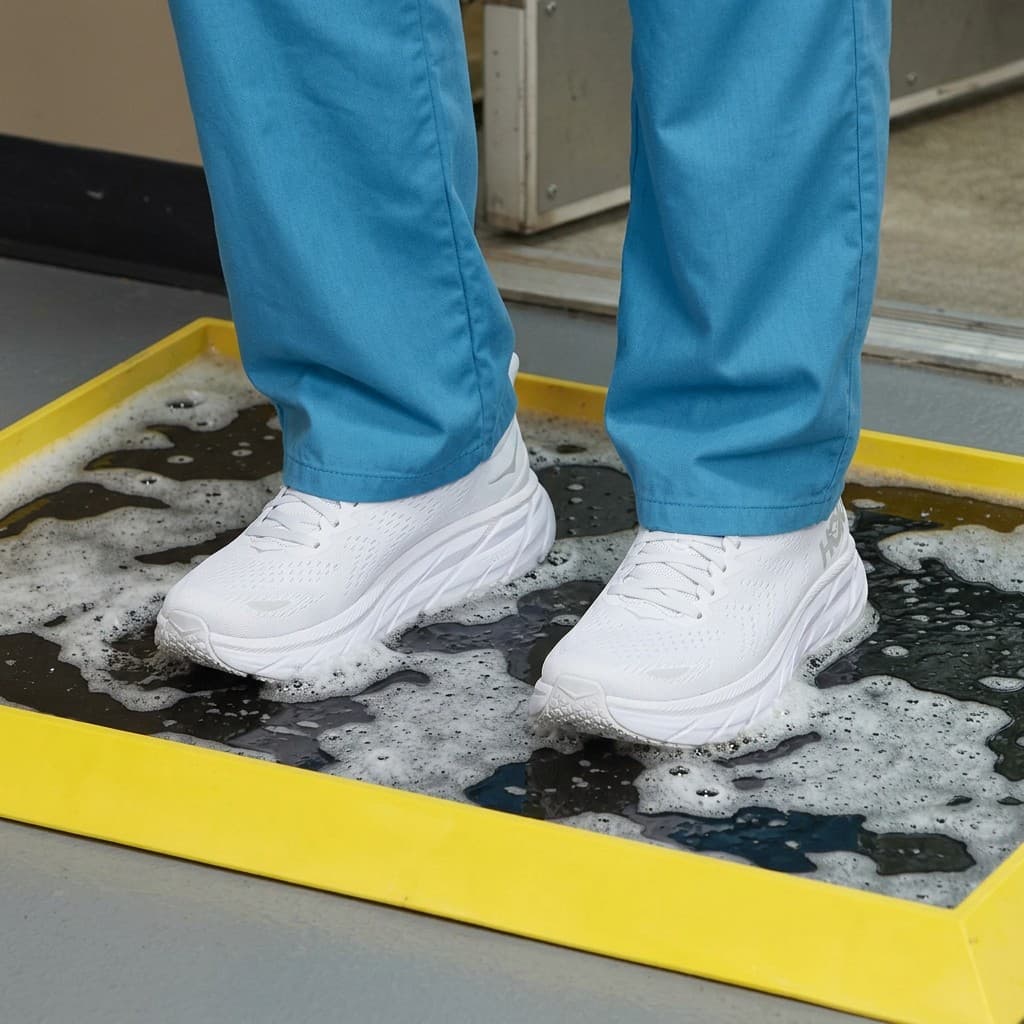 Chemical mats
 UVZone®
UVZone® does not require a liquid chemical bath during normal operation. Your facility still decides where chemical mats, cleaning procedures, personal protective equipment, dedicated footwear, and other controls remain required.
For commercial facilities reviewing employee entrances, production transitions, controlled areas, cleanrooms, laboratories, agricultural operations, and other selected entry points.
The Process You Manage Today
Your Chemical Mat Process Has to Work Every Time Someone Enters
Footbaths and chemical mats can be appropriate controls when they are correctly prepared, monitored, maintained, and replaced. The challenge is keeping that process consistent at every selected entry, through every shift, and under changing traffic and operating conditions.
When your team evaluates the process, the mat itself is only one part of the requirement. You also need to account for the chemical solution, preparation method, contact requirements, inspections, records, refilling, cleanup, and disposal.
Burden 1
Your team must prepare and verify the solution.
The disinfectant must be prepared or supplied at the concentration required by your procedure. Traffic, dilution, debris, and organic load can change the condition of the solution, so your team needs a defined way to inspect it and determine when it must be replaced.
Burden 2
Your procedure must address contact time and employee use.
Personnel must make the contact required by the procedure governing the mat or footbath. Shift changes, high traffic, and multiple entrances can make that harder to observe and document consistently.
Burden 3
Each entry becomes a separate monitoring point.
Your team may need to record concentration, solution condition, refill timing, observed use, and corrective actions according to the requirements established for that location.
Burden 4
Wet chemistry adds handling, cleanup, and disposal work.
Each selected entry may require solution storage, preparation, refill access, spill response, cleanup, and disposal. Moisture and debris can also move beyond the threshold and add work around the entry.
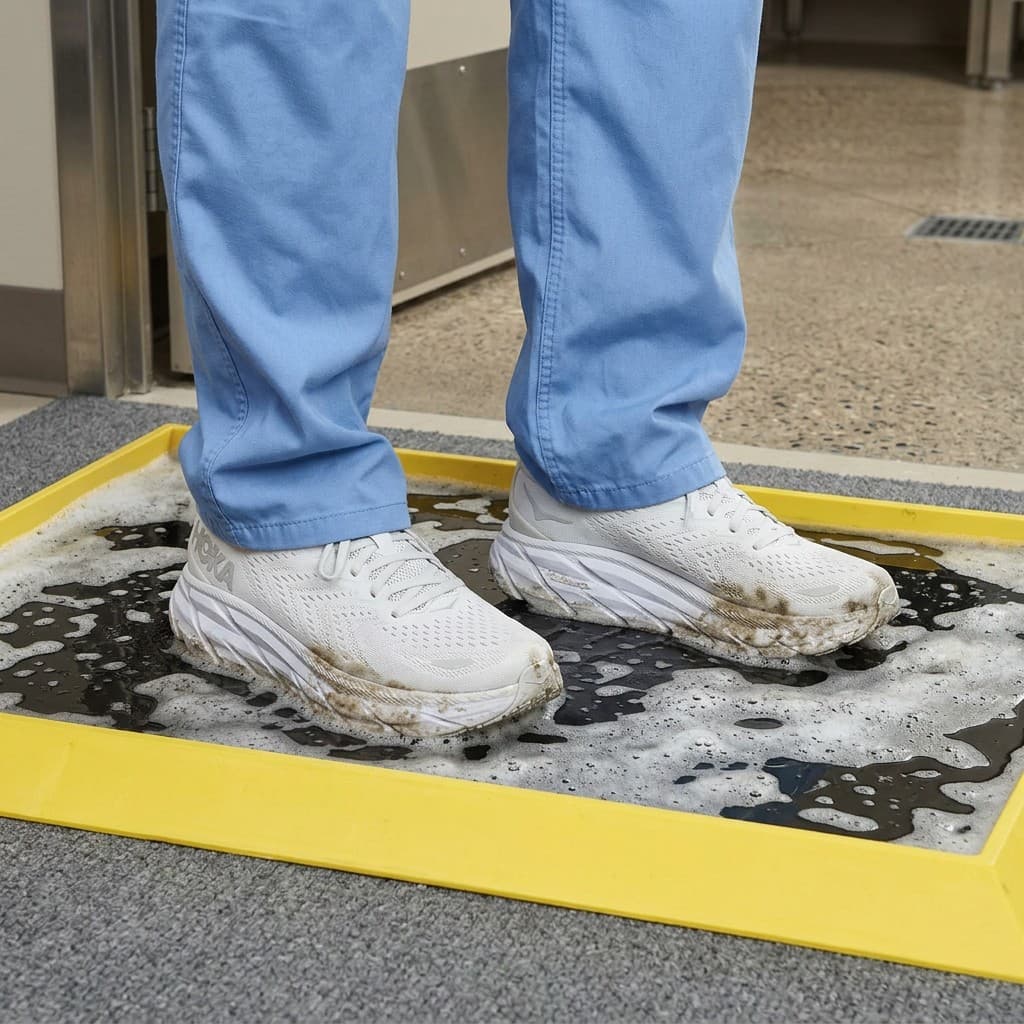
Compare commercial sanitizing mats with UVZone® at selected facility entry points.
The UVZone® Process
How UVZone® Changes the Work at the Entry
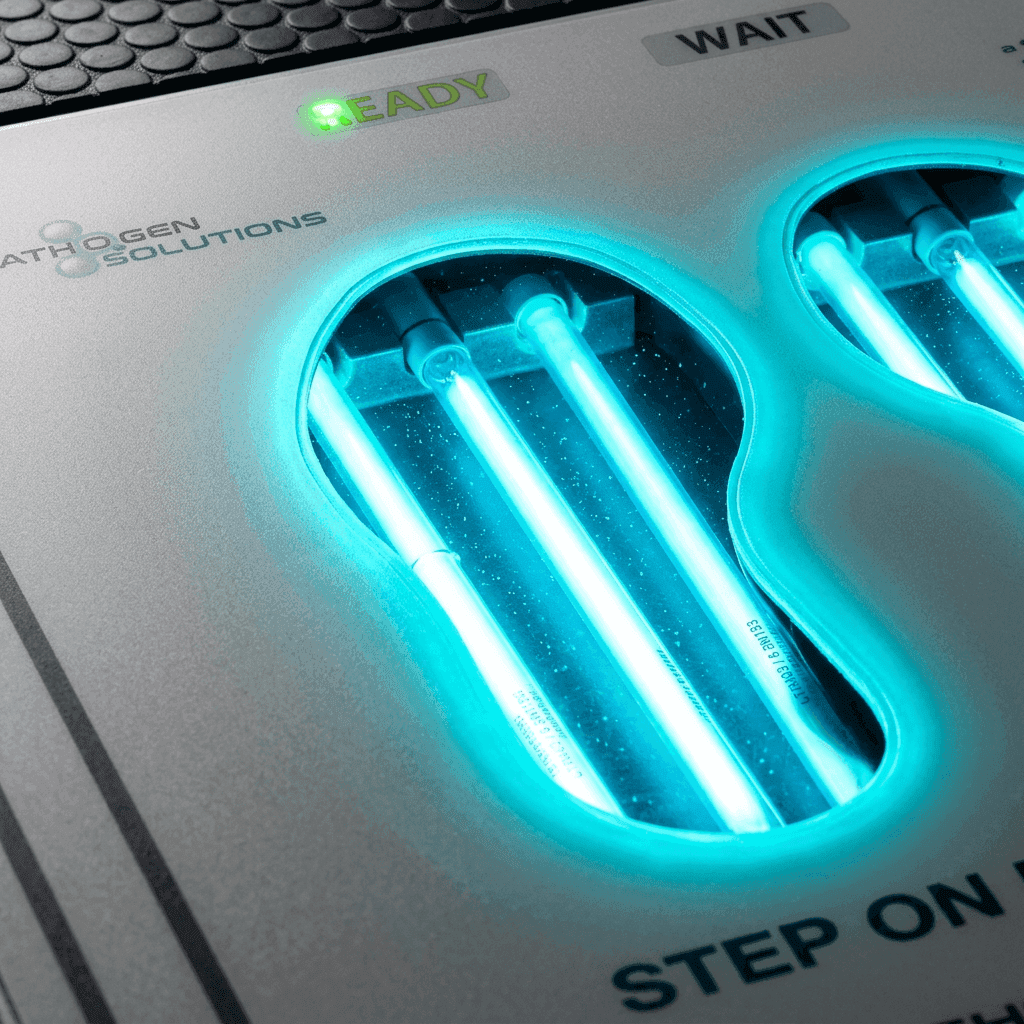
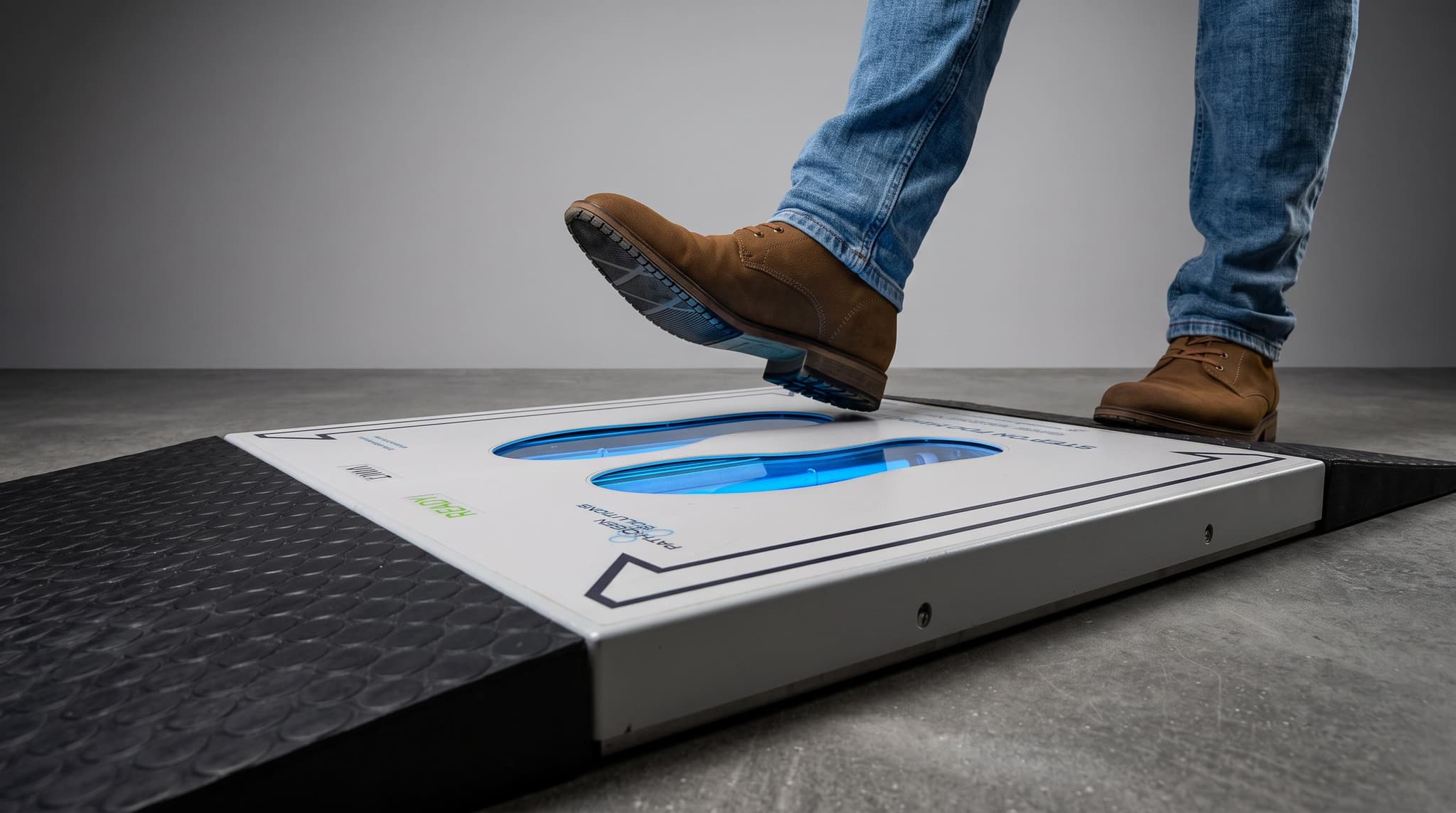
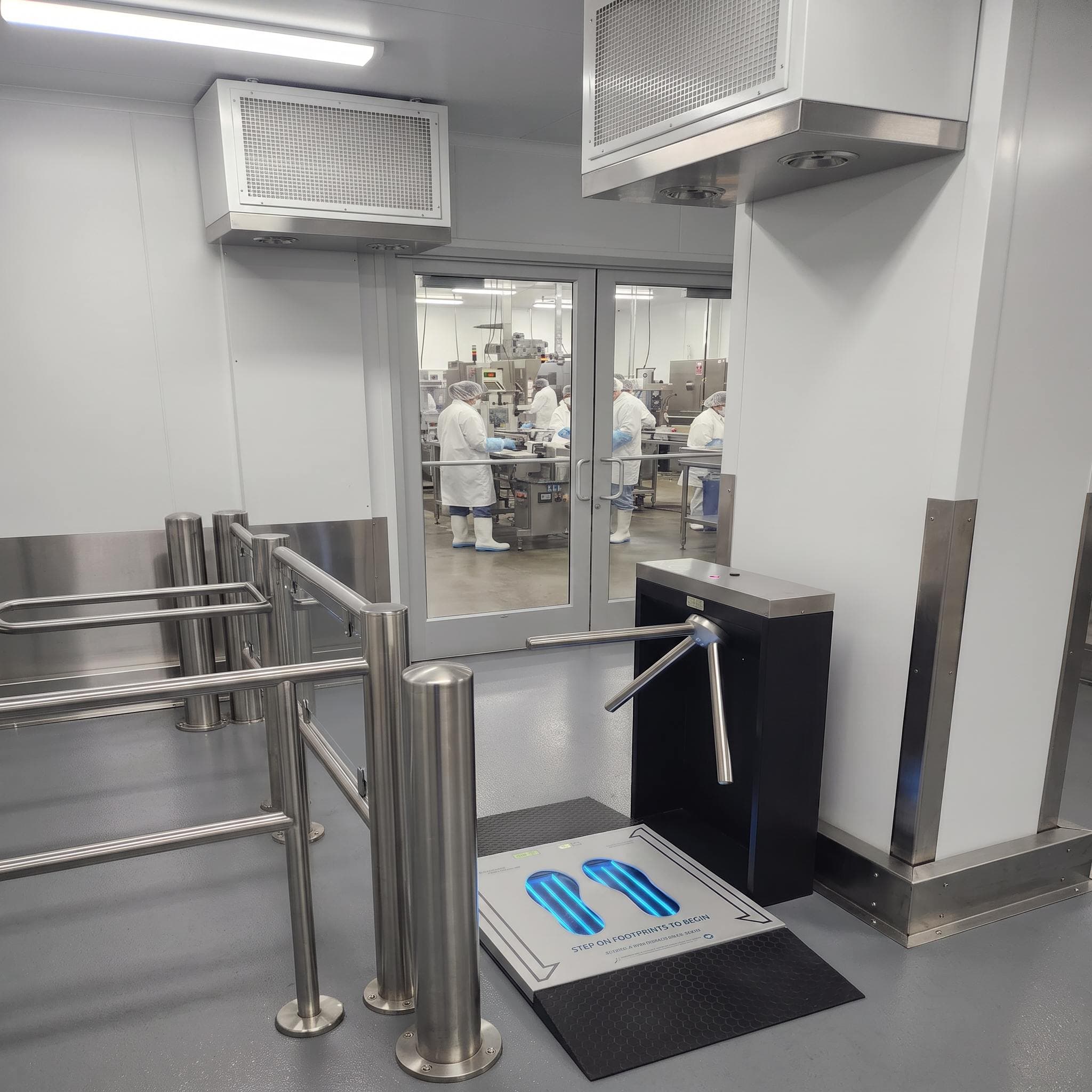
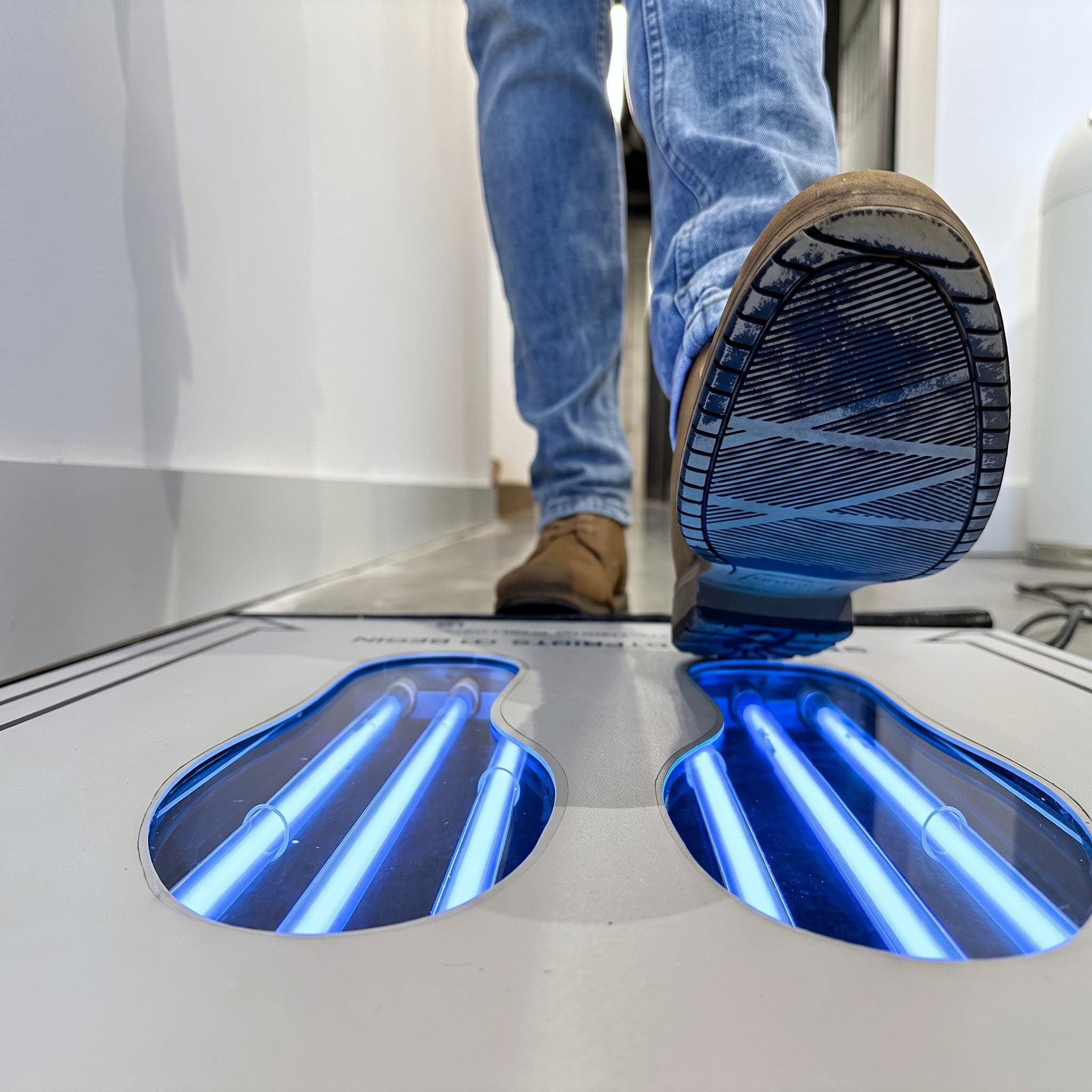
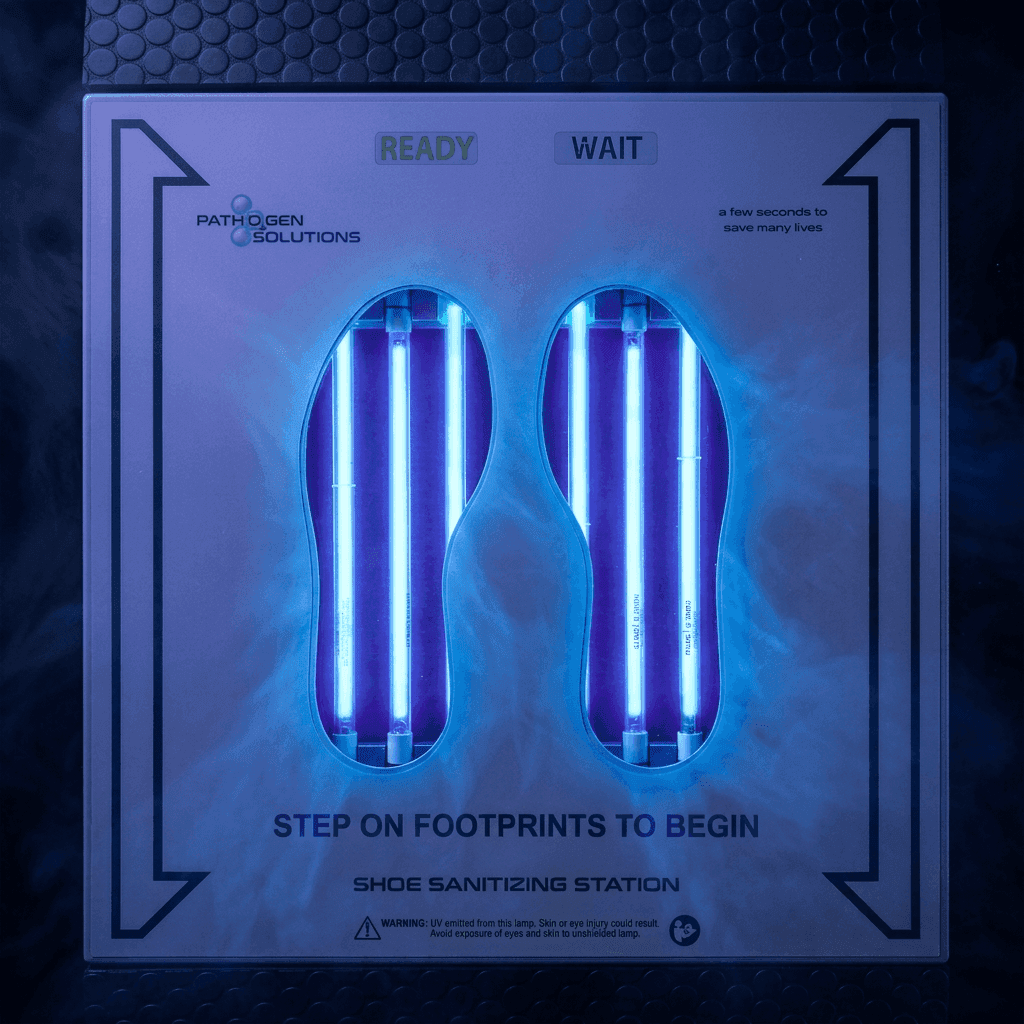
UVZone® adds a dry, automatic shoe-sole treatment step at an appropriate entrance or controlled transition point. When a user steps onto the station, automatic weight sensors activate the factory-set treatment cycle.
UV-C light and ozone treat both shoe soles simultaneously during the cycle. Visual and audible indicators tell the user when the cycle is complete and the person can continue through the entry.
Advantage 1
Your team does not prepare a liquid bath at the station.
UVZone® does not require the solution mixing, concentration checks, refilling, or liquid disposal associated with a chemical footbath during normal operation.
Advantage 2
Each completed use follows the factory-set treatment cycle.
The treatment-cycle setting is established at 6, 8, or 10 seconds. Both shoe soles are treated during the same activated cycle.
Advantage 3
The station remains fixed at the selected entry.
Your facility must provide a suitable indoor location, access to power, a clear walking path, appropriate ventilation, and enough doorway clearance for safe placement and use.
Operating requirement
The equipment still requires inspection and maintenance.
UVZone® must be inspected, cleaned, operated, and maintained in accordance with the current Instructions for Use and your facility procedures. It must not be described as maintenance free.
Review solution checks, refilling, cleanup and disposal against UVZone® requirements.
A Practical Comparison
Compare the Work Your Team Has to Manage
We do not assume that one method belongs at every door. We compare the actual requirements of your current chemical mat or footbath process with the space, power, operation, maintenance, and traffic requirements of UVZone®.
UVZone® treats both shoe soles during a factory-set 6, 8, or 10-second cycle.
Facility Application
Where a Fixed Footwear-Treatment Station May Make Sense
UVZone® may be worth reviewing when your team manages chemical mats across multiple shifts or entries, when wet tracking and refill routes create additional work, or when you want a consistent timed treatment step at a selected transition.
The right placement depends on your facility layout, traffic flow, operating procedures, ventilation, power, footwear condition, and contamination-control objectives.
Employee and production entrances
At an employee or production entrance, UVZone® can provide a repeatable shoe-sole treatment step before personnel continue into the next area.
Controlled and secondary transitions
At a controlled transition, UVZone® may add another footwear-treatment step without requiring an additional liquid bath at that location.
Facilities that use more than one footwear control
Your facility may still require physical cleaning, chemical mats, shoe covers, dedicated footwear, or another control at the same entry or at a different point in the process. We can help your team evaluate where UVZone® may fit within the procedures you already maintain.
Application Limits
UVZone® Treats Shoe Soles. Your Existing Requirements Still Matter.
UVZone® treats the undersides of shoes during an activated treatment cycle. It does not continuously treat the room, the facility, or the footwear after the user steps off the station.
If footwear requires physical cleaning, that cleaning step remains necessary. If your procedure requires chemical treatment, shoe covers, dedicated footwear, hand hygiene, personal protective equipment, environmental cleaning, sanitation, traffic controls, or another facility control, that requirement remains in place until the responsible facility team approves a change.
UVZone® is intended to complement a broader contamination-control, hygiene, infection-prevention, or biosecurity program. It does not independently establish compliance or guarantee a facility-specific result.
Tell us how your entry works.
We will help your team compare the operating requirements.
Independent Testing
Review the Laboratory Data Before You Make a Facility Decision
Independent laboratory testing demonstrated that UVZone® reduced specified microorganisms on tested carriers under defined treatment conditions. Results vary by organism, treatment time, carrier, and study method.
Independent laboratory testing demonstrated reductions of up to 99.9993% for specific organisms under defined test conditions and treatment times. That maximum result does not describe every organism, treatment cycle, footwear material, facility, or operating condition.
We can provide the applicable study summary or full report with the organism, reported reduction, treatment time, laboratory, test conditions, and report identification for your team to review.
Laboratory results do not guarantee facility-wide contamination, infection, compliance, operational, or financial outcomes.
Start With One Entry
Compare the Process at the Door You Are Already Managing
You do not need to begin with a facility-wide recommendation. Start with the entry where your team is already preparing, checking, refilling, documenting, or cleaning around a chemical mat or footbath.
Step 1
Tell us how the entry works today.
Tell us who uses the entry, what footwear process is currently required, how many people pass through it, and what your team has to manage during a normal shift.
Step 2
We compare the operating requirements.
We will help you compare your current preparation, monitoring, refill, cleanup, and disposal process with the location, power, cycle, operation, and maintenance requirements of UVZone®.
Step 3
Your team decides whether the station fits.
Your facility remains responsible for determining where chemical mats and other controls remain required. We provide the product information, laboratory documentation, and entry requirements your team needs for its review.
Common Questions
Questions Facilities Ask About Chemical Mats and UVZone®
Request an Entry Review
Tell Us How You Manage Footwear at the Entry
Tell us which entry uses a chemical mat or footbath, who passes through it, and what your team has to manage each day. We will help you compare the recurring wet-chemistry process with the space, power, operation, and maintenance required for UVZone®.
Request a Chemical Mat and Footbath Comparison
Share the entry and process your facility is reviewing
We respect your privacy. Your information will never be shared.
Request an Entry Review
Tell us how your entry works
We respect your privacy. Your information will never be shared.